A StoryTraining companion · Hadiya Nuriddin
A polished story shows you the destination. A flawed story lets you practice the journey.
Twenty-five cases that each begin with something that is not working. See the first version, diagnose it yourself, then compare your thinking with the makeover.
Available as a digital copy only for now. Pay $6.99 and download the full PDF instantly after checkout.
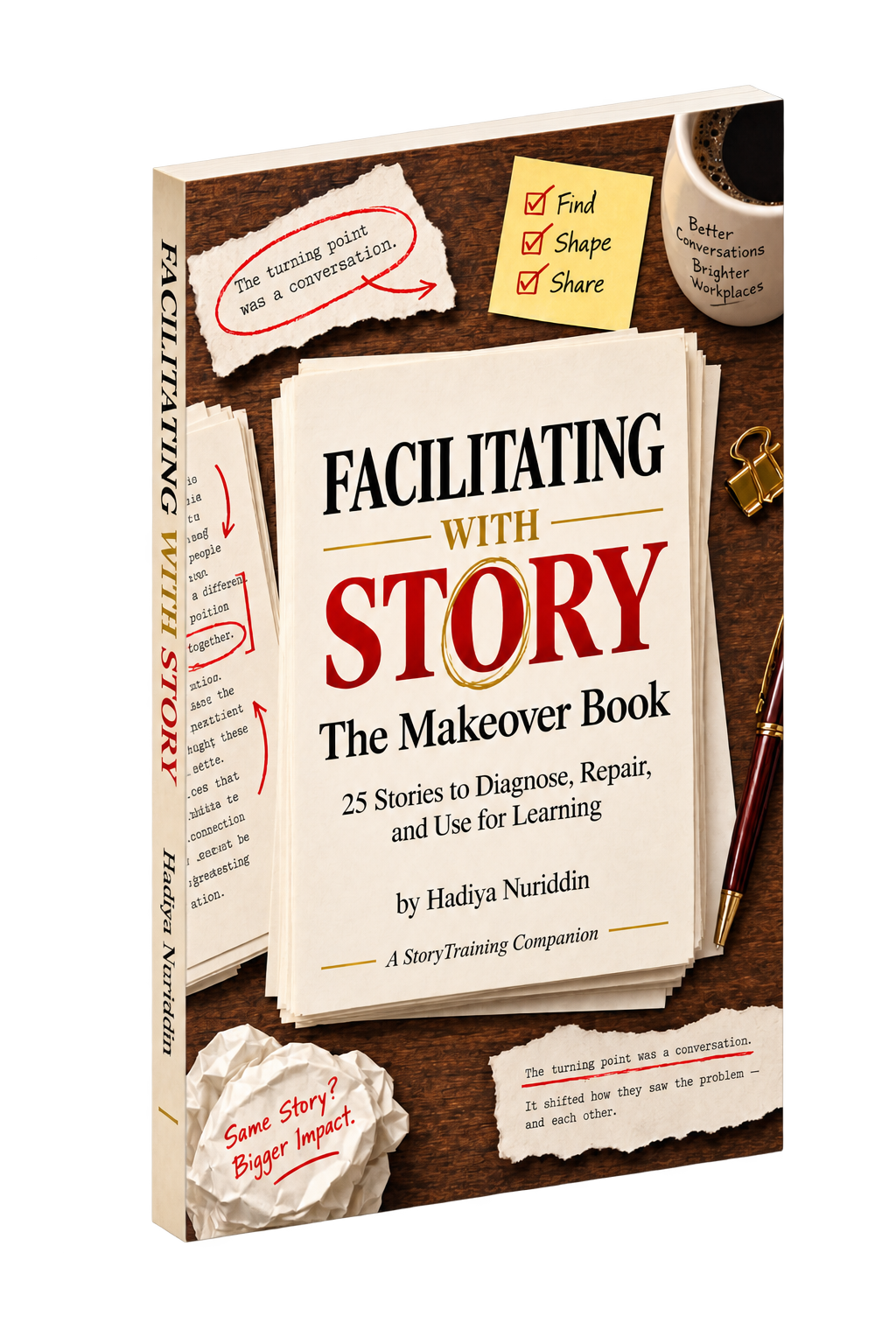
People who've read StoryTraining understand the ideas, then ask for the same thing: examples.
Not just examples of polished stories, but examples that show how the thinking works. What does a story look like before it is shaped? How can you tell what is wrong with it? What should be removed, expanded, reframed, or facilitated differently? How does a facilitator move from remembering an experience to using that experience intentionally for learning?
That is the purpose of this book.
Instead of explaining the methodology again, it turns the methodology into problems to solve. A story may contain too much context, no meaningful change, weak causality, the wrong focal point, or a protagonist with no agency. A facilitator may attach a moral too quickly, ask a question that is not genuinely open, perform a story without involving learners, or use physical storytelling in a way that distracts rather than clarifies.
The revised version is never presented as the one correct story. It is an example of what happens when the principles of StoryTraining are applied deliberately. Another storyteller could make different choices and still produce an effective result. The point is to make the choices visible.
Case 1 · The Story That Goes Nowhere
You are teaching new supervisors about dealing with performance problems early.
A discussion about attendance reminds you of an employee from your first management job, so you decide to tell the story.
“When I was a new manager, I had an employee who was late all the time. It was unbelievable. She was probably late three days a week… She always came running in with coffee and apologized, and then a few days later she would do it again.”
“The frustrating thing was that she was actually a very good employee. That was probably why I kept letting it go. It drove me crazy.”
“So the lesson is that you really have to deal with attendance problems.”
An ongoing condition, not a story. Nothing forces anyone to act. No key event. Nothing changes.
“It got worse. One morning she was almost thirty minutes late. Another employee was waiting for her because she had access to information he needed for an early client call. When she finally arrived, he came straight into my office and said, ‘Are you ever going to do anything about this?’
“That was the first time I realized the problem was not just between me and the employee who was late. Everyone else had been watching me not manage it.
“I was prepared for an argument. Instead she looked genuinely confused and asked, ‘Why didn't you tell me?’ I didn't have a good answer.”
The facilitator stops there and asks, “Who created the bigger problem?”
What changed and why
The revised version introduces a key event: the co-worker's confrontation. That event exposes the consequences of the manager's avoidance and forces action. The employee's response then creates the change. The manager sees that silence was not a neutral choice. The story is no longer merely about punctuality. It can support a broader conversation about avoidance, expectations, and accountability.
How each case works
The Situation
Where you are, who you are teaching, and why this story came to mind in the first place.
The First Version
The complete flawed story. Read it before the diagnosis. Notice where your attention drifts.
What's Going Wrong
The diagnosis: the missing key event, the detail derail, the borrowed lesson, the absent agency.
The Makeover & Try It
The revised story, what changed and why, and a prompt to apply the same thinking to a story of your own.
Resist the urge to ask only, “Is this a good story?” Ask instead
- What is this story supposed to do?
- Where is the key event?
- What changes?
- Which details serve the intent?
- Who has agency?
- What meaning should learners construct?
- Where can learners enter the experience?
- What does this story need to become a better facilitation tool?
Who it's for
Facilitators, trainers, coaches, and learning professionals who want to use stories more intentionally. The examples are fictional, but the problems are familiar to anyone who has stood in front of a group and wondered whether a story was helping the learning — or simply taking up time.
If you already use stories in training, this book will help you sharpen them. If you are just beginning, it will give you a practical way to see what makes a story useful in the first place.